From Being Covered to Being Denied: What’s Changing in Cyber Insurance for Businesses in 2026
For years, cyber insurance has been seen as a safety net for businesses.
The assumption was simple: if something goes wrong, a breach, ransomware attack, or data loss, insurance will step in and cover the damage.
But in 2026, that assumption is starting to break across the U.S. Businesses are discovering something unexpected after a cyberattack:
Their insurance claims are being denied, not because they didn’t have coverage, but because their security didn’t meet the required standards.
Why Cyber Insurance Claims Are Being Denied More Frequently
Cyber insurance providers are no longer just evaluating the attack itself; they are evaluating the security posture of the business before the attack happened.
Recent industry data shows that a significant percentage of cyber insurance claims are either partially paid or denied altogether. In many cases, the denial is tied to gaps in security controls rather than the severity of the incident.
One of the most common issues is incomplete or improperly enforced security measures, especially around identity protection.
This means that having insurance is no longer enough. Businesses must now prove that they followed specific security practices in order to qualify for coverage.
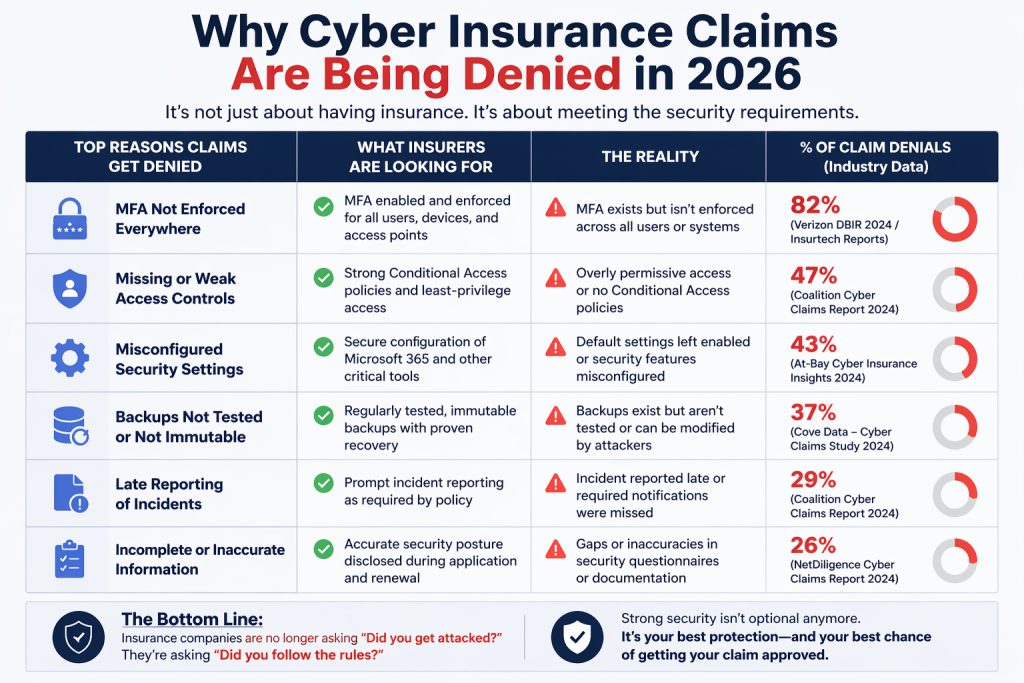
A Real-World Scenario: When MFA Isn’t Enough
In a recent U.S.-based case, a company experienced a ransomware attack and filed a cyber insurance claim expecting coverage.
The claim was denied.
The reason was not the attack itself, but the fact that Multi-Factor Authentication (MFA) was not fully enforced across the organization. While MFA existed in parts of the environment, it was not consistently applied to all users and access points.
From the insurer’s perspective, this created a preventable vulnerability.
As a result, the company was left covering the financial impact of the attack on its own.
This type of situation is becoming more common as insurers tighten their requirements.
What Insurance Providers Are Actually Looking For
Cyber insurance providers are now focused on whether businesses have implemented and maintained specific security controls.
In many cases, claims are denied due to issues such as:
- MFA not enforced across all users and systems
- Lack of Conditional Access policies
- Misconfigured security settings in Microsoft 365
- Missing or incomplete monitoring and logging
- Backups that are not tested or verified
- Inaccurate information provided during the policy application
These requirements are not new, but enforcement has become significantly stricter.
The shift is clear: insurance providers expect businesses to take a proactive approach to cybersecurity, not a reactive one.
Why Having Microsoft 365 Doesn’t Automatically Mean You’re Secure
Many businesses assume that because they are using Microsoft 365, they are already protected.
While Microsoft provides powerful security tools, those tools must be properly configured and managed to be effective.
Without proper setup:
- MFA may not be enforced across all access points
- Users may have more permissions than necessary
- Security alerts may go unnoticed
- Policies may not align with current threat landscapes
In other words, the tools are there, but the protection depends on how they are implemented.
The Role of Security Baselines in Meeting Insurance Requirements
To meet modern cyber insurance requirements, businesses need a structured approach to security.
This is where a security baseline becomes critical.
A properly implemented Microsoft 365 Security Baseline ensures that essential controls, such as MFA, email protection, and identity security are configured according to best practices and aligned with industry expectations.
These controls are not only important for preventing attacks but are often directly tied to insurance eligibility.
CSE’s Security Baseline services are designed to help businesses establish and maintain these configurations, ensuring that their environment is both secure and compliant with evolving requirements
Why Monitoring and Response Matter More Than Ever
Another key factor in claim approval is the ability to detect and respond to threats quickly.
Cyberattacks no longer happen during business hours. They occur overnight, on weekends, and during periods when internal teams may not be actively monitoring systems.
Without continuous visibility, incidents can escalate before action is taken.
This is why 24/7 monitoring and response capabilities are becoming a critical part of modern cybersecurity strategies. Businesses need to demonstrate not only that they have protections in place, but that they are actively monitoring and managing them.
CSE’s managed security services provide ongoing monitoring, threat detection, and response to help businesses stay ahead of potential risks and maintain operational continuity
What This Means for Your Business
The shift in cyber insurance is changing how businesses need to think about security.
It is no longer enough to assume that coverage will protect you after an incident. The focus is now on prevention, configuration, and proof.
Businesses that fail to meet these expectations face two major risks:
- The financial impact of a cyberattack
- The possibility of having no insurance coverage when they need it most
At the same time, businesses that align their security practices with modern requirements are better positioned to reduce risk and ensure that their coverage remains valid.
Conclusion
Cyber insurance is no longer a guaranteed safety net.
It has become a conditional layer of protection that depends on how well your security is implemented and maintained.
The difference between a claim being approved or denied often comes down to configuration, visibility, and control.
If your business has not reviewed its security posture recently, now is the time to do so.
At Computer Solutions East, we help businesses like yours close the exact gaps insurers look for, from Microsoft 365 Security Baselines and endpoint protection to 24/7 threat monitoring and compliance alignment
Schedule a quick security assessment today and find out where you actually stand.
FAQs
Why are cyber insurance claims being denied more often?
Claims are often denied because businesses fail to meet required security standards, such as enforcing MFA, maintaining proper configurations, or providing accurate information during the policy process.
Is having MFA enough to meet cyber insurance requirements?
No. MFA must be properly enforced across all users, devices, and access points. Partial or inconsistent implementation can still lead to claim denial.
Does Microsoft 365 provide enough security by default?
Microsoft 365 includes strong security tools, but they must be configured correctly. Without proper setup, businesses may still be vulnerable to attacks.
What is a security baseline and why is it important?
A security baseline is a set of standardized configurations that ensure essential protections are in place. It helps businesses align with best practices and meet insurance requirements.
How can businesses reduce the risk of claim denial?
By implementing structured security controls, enforcing identity protection measures, maintaining monitoring systems, and regularly reviewing their environment for gaps.