Businesses Modernized Communication Faster Than Security
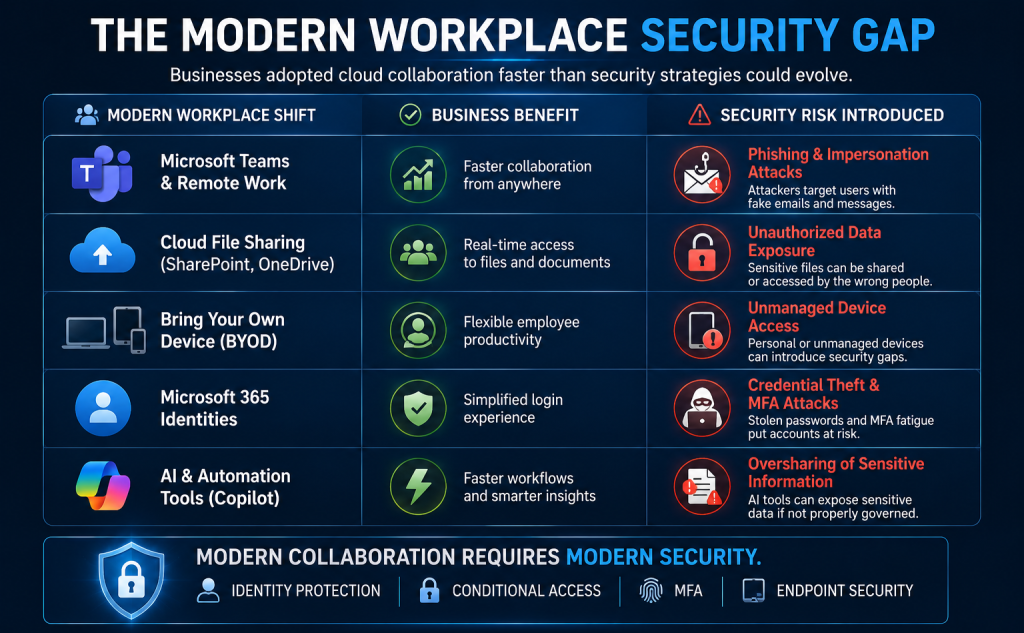
Over the past few years, businesses transformed how employees communicate and collaborate faster than almost anyone expected.
Organizations rapidly adopted Microsoft Teams, cloud file sharing, remote access, Microsoft 365, and hybrid work environments to keep operations moving efficiently. What started as a temporary shift quickly became the new standard for modern business operations.
Today, employees work from:
- home offices
- airports
Virtually anywhere else with internet access.
The modern workplace became more flexible, collaborative, and connected than ever before.
But while communication evolved rapidly, security strategies often struggled to keep up.
The Modern Workplace Expanded Faster Than Traditional Security Models
Many businesses built their original security strategies around physical offices.
Employees worked inside company buildings. Devices stayed on internal networks. Access to sensitive systems was easier to control because the workplace itself was centralized.
Modern cloud environments changed all of that.
Employees now connect to business systems from personal devices, public networks, mobile phones, shared workspaces, and remote locations every single day. Microsoft 365 made collaboration dramatically easier, but it also expanded how businesses must think about protecting users, identities, and data.
The office firewall is no longer the main security perimeter.
Identity became the new frontline.
Collaboration Became Easier. Attackers Adapted Too.
Cybercriminals understand that businesses now rely heavily on cloud collaboration platforms.
Modern attacks increasingly focus on:
- compromised Microsoft 365 accounts
- phishing and AI-generated impersonation
- stolen credentials
- session hijacking
- MFA fatigue attacks
Instead of attacking infrastructure directly, many attackers now target users themselves.
And because cloud ecosystems are deeply interconnected, a single compromised account can potentially affect emails, shared files, Teams collaboration, OneDrive storage, and sensitive business information simultaneously.
That’s why modern security conversations are shifting away from traditional perimeter-only protection.
Businesses now need visibility and protection around:
- identities
- devices
- access
- and cloud environments
Identity-Based Attacks Are Rising Fast
Recent cybersecurity reports show just how quickly these threats are evolving. According to Microsoft’s Digital Defense Report, identity-based attacks surged by 32% during the first half of 2025, while attackers increasingly shifted toward phishing, credential theft, and cloud-focused compromises targeting Microsoft environments. At the same time, Microsoft reported that modern cybercriminals are moving away from traditional infrastructure-only attacks and focusing more heavily on identities, cloud services, and remote collaboration platforms used by businesses every day.
Communication Platforms Are Now Business-Critical Systems
Microsoft Teams, Outlook, SharePoint, and OneDrive are no longer “supporting tools.”
For many organizations, they ARE the workplace.
Daily operations now depend on:
- cloud collaboration
- real-time communication
- remote productivity
- centralized access to files and workflows
That operational dependency means disruptions can have a much larger impact than businesses expect.
A compromised account today doesn’t simply create an IT inconvenience.
It can interrupt communication, expose sensitive information, delay operations, and create compliance concerns across the organization.
Why Businesses Are Paying More Attention to Security Baselines
As cloud collaboration environments continue growing, businesses are realizing they need stronger foundational security strategies around Microsoft 365.
That’s where modern security baselines become increasingly important.
Microsoft Security Baselines help organizations standardize and strengthen protections across cloud environments using recommended security configurations and centralized policy management.
This includes technologies and protections such as:
- Multi-Factor Authentication (MFA)
- Conditional Access
- email protection
- endpoint security
- anti-phishing policies
- identity protection
- and data security controls
Modern security is no longer just about blocking threats.
It’s about controlling access, reducing exposure, and improving resilience across the entire workplace ecosystem.
The Future of Work Requires a Different Security Strategy
Businesses are continuing to move toward:
- AI-powered workflows
- remote collaboration
- cloud-managed environments
- centralized identity management
- and flexible work models
That evolution is not slowing down.
Microsoft’s modern workplace ecosystem continues expanding through tools like Teams, SharePoint, OneDrive, Intune, Defender, and Microsoft Copilot.
As businesses modernize communication and productivity, security strategies must evolve alongside them.
Because modern collaboration without modern security creates unnecessary business risk.
How CSE Helps Businesses Secure Modern Work Environments
CSE helps organizations modernize and secure Microsoft environments through:
- Microsoft 365 Security Baseline services
- identity protection strategies
- Managed Security Services
- cloud modernization
- endpoint protection
- Conditional Access implementation
- and Microsoft ecosystem management
CSE’s Security Baseline services include protections such as MFA enforcement, anti-phishing policies, Conditional Access, endpoint protection, and advanced threat security designed to strengthen modern Microsoft 365 environments.
As businesses continue adopting cloud-first operations, securing identities and collaboration platforms is becoming just as important as enabling them.
Conclusion
Businesses modernized communication faster than security.
Cloud collaboration transformed productivity, flexibility, and remote work capabilities almost overnight. But that same transformation also changed how organizations must think about protection, access, and resilience.
The workplace is no longer limited to office buildings or company-owned devices.
Modern business now operates through identities, cloud platforms, and connected ecosystems.
And that means modern security strategies must evolve too.
Want to know what real Microsoft 365 security is?
FAQs
Why are businesses becoming more concerned about Microsoft 365 security?
Modern businesses now rely heavily on cloud collaboration platforms like Microsoft Teams, OneDrive, SharePoint, and Outlook for daily operations. As remote work and cloud access continue expanding, cybercriminals are increasingly targeting identities, user accounts, and cloud environments instead of only traditional infrastructure.
What is a Microsoft 365 Security Baseline?
A Microsoft 365 Security Baseline is a collection of recommended security configurations designed to strengthen protection across Microsoft environments. These baselines often include Multi-Factor Authentication (MFA), Conditional Access, email protection, identity security, endpoint management, and advanced threat protection.
Why is identity security becoming so important?
Modern cyberattacks increasingly focus on compromising user accounts rather than directly attacking servers or networks. A compromised identity can potentially expose emails, cloud files, Teams conversations, and sensitive business information across multiple systems connected to Microsoft 365.
How does Multi-Factor Authentication (MFA) help businesses?
MFA adds an additional layer of security by requiring users to verify their identity beyond just a password. Even if login credentials become compromised, MFA helps reduce unauthorized access attempts and strengthens protection for Microsoft 365 accounts and cloud applications.
How can CSE help secure modern cloud work environments?
CSE helps businesses modernize and secure Microsoft environments through Microsoft 365 Security Baseline services, Managed Security Services, identity protection strategies, Conditional Access implementation, endpoint protection, and cloud modernization solutions designed for today’s hybrid and remote work environments.
Share This Post