
Financial Services
SECURE
Customer & financial data
Identity & access controls
Security monitoring & response
Compliance & business continuity
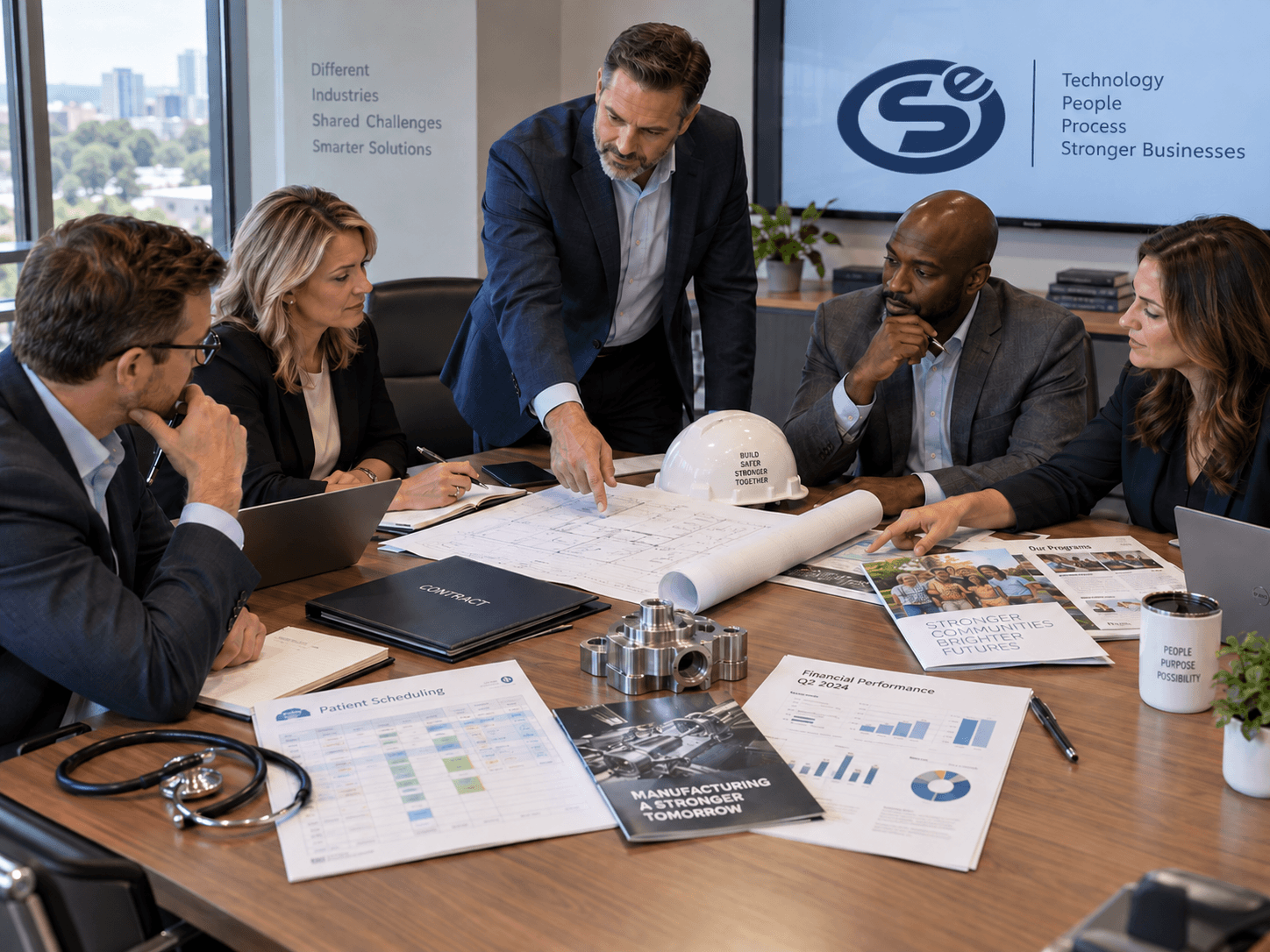
A law firm, healthcare practice, financial company, manufacturer, nonprofit, and construction business may all use Microsoft 365, cloud infrastructure, laptops, networks, and security tools. What changes is what those systems are protecting, how employees use them, what happens when they fail, and which requirements the organization has to answer for. CSE works from those differences first, then builds the technology, security, support, and transformation strategy around the way the organization actually operates.

An hour of downtime at a professional services firm is frustrating. An hour of downtime on a production floor can stop operations. A misplaced document may be inconvenient in one organization and become a confidentiality or compliance issue in another. A remote employee may simply need secure access from home, while a field team may need that same access from a temporary job site with unreliable connectivity. That is why industry context matters. The technology may look familiar, but the business impact behind it can be completely different.
We look at how the organization makes money, serves customers, delivers its work, and depends on technology during a normal day. That tells us which systems cannot become an afterthought.
Different industries face different expectations around privacy, security, evidence, access, retention, and third-party risk. Those requirements should influence the environment before an audit or customer questionnaire forces the issue.
Some employees sit behind desks. Others work from clinics, courtrooms, plants, customer offices, classrooms, or job sites. The workplace has to support those realities without turning every location into its own IT environment.
New employees, locations, contracts, customers, regulations, acquisitions, and technology can all change what the organization needs. The environment should be able to evolve without being redesigned from scratch every year.

Industry differences become much clearer when you follow the work itself. A financial employee may move sensitive customer information between CRM, email, documents, and reporting systems. A healthcare employee may need immediate access to patient information while moving between rooms and devices. A construction employee may work from a temporary site hundreds of miles from headquarters. The technology conversation becomes more useful once those realities are understood. CSE looks at where employees work, what information follows them, which systems keep the business moving, and what happens if access disappears. That context helps determine which services, controls, and investments actually matter.
Technology handled while the business keeps moving.
CSE supports organizations across industries where technology has to do more than stay online. Security requirements, customer expectations, remote work, compliance, operational continuity, and limited internal IT resources all shape what the environment needs to look like.
A generic IT assessment asks what servers, applications, and devices an organization has. An industry-focused conversation goes further. What do customers, regulators, insurers, or contracting partners expect the organization to demonstrate? Which employees work outside the traditional office? And where is the business growing faster than the current environment can support? Those answers shape what should be secured, managed, modernized, backed up, automated, or left alone.
Employees still need technology that works when they need it. CSE can manage or support the service desk, devices, infrastructure, networks, Microsoft environment, monitoring, and ongoing technology operations around the organization’s preferred service model.
Every industry has information, identities, devices, and systems worth protecting. The security strategy may change by sector, but clear access, endpoint protection, threat monitoring, security baselines, and defined response processes remain important foundations.
Microsoft 365 and Azure can support collaboration, communication, infrastructure, applications, and remote work across many industries. CSE helps configure those platforms around the organization instead of assuming the same architecture works everywhere.
The value of backup depends on what the organization cannot afford to lose and how quickly the work needs to continue. CSE helps define protection, ownership, recovery expectations, and the systems that matter most during an outage.
Some organizations answer to formal regulations. Others answer to customers, insurers, contracts, or internal governance. CSE helps translate those expectations into practical technical and operational control
AI, automation, Power Platform, Copilot, and business applications can improve work across many industries, but the useful opportunities are different in each one. CSE starts with the process and business outcome before choosing the technology.
CSE works across Microsoft cloud, security, data and AI, infrastructure, applications, and business applications. That allows industry conversations to span the broader environment instead of stopping at one product or technical discipline.
Some organizations need an ongoing IT partner. Others already have internal IT and need additional capacity. Others need a specific migration, security, compliance, AI, network, or business application initiative. The engagement model can reflect the organization rather than forcing every customer into the same service.
Security touches identity, endpoints, email, cloud services, applications, networks, backup, and employees. CSE can address those areas as part of the broader technology environment rather than treating security as a separate product.
Organizations may operate across multiple offices, job sites, remote employees, customer locations, or facilities. The support model needs to reflect where the business actually operates.

CSE Statement“Industry expertise is not knowing which software a company uses. It is understanding what happens to that company when the technology does not do its job.”
Technology priorities can be tied more directly to operational risk, employees, customer expectations, compliance, and business growth instead of being driven only by technical lifecycle decisions.
Business leaders can see why an investment matters, what risk or limitation it addresses, and how it supports the organization rather than receiving a roadmap written entirely in technical terms.
Support for your people, management of devices and servers, security monitoring, backup, Microsoft 365 administration, and ongoing technology planning. Scope is agreed up front.
Yes. That is the co-managed model — CSE covers after-hours coverage, security operations and project work while your internal team keeps what it does best.
Yes. CSE runs a NOC and SOC on a 24/7/365 basis, so monitoring and security response continue outside business hours.
Yes. Devices are managed wherever they are, and access policies are configured so remote work does not weaken security.
Yes. Administration, licensing, security baselines and adoption are part of the service, backed by Microsoft Solutions Partner designations.
Small and midsize organizations across the United States, with or without an internal IT team. If CSE is not the right fit, we will say so.
Let’s look at what’s working, what’s creating risk, and where CSE can take work off your team’s plate.