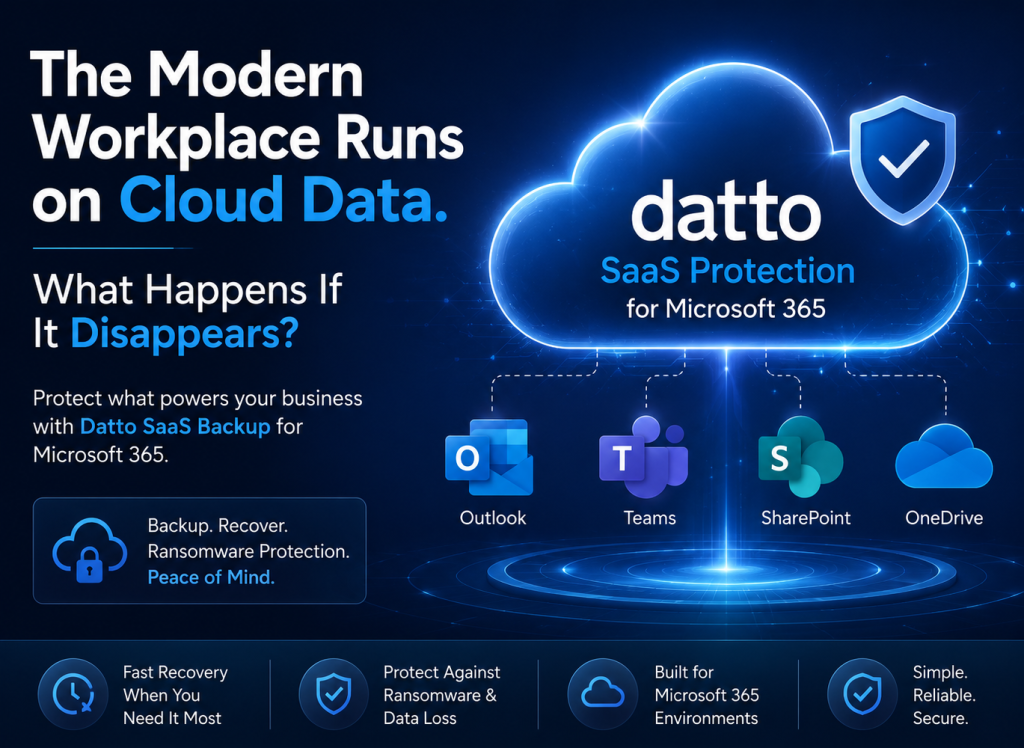
The Modern Workplace Runs on Cloud Data, What Happens If It Disappears?
For years, businesses focused heavily on protecting physical infrastructure.
Servers sat inside office buildings. Files lived on local drives. Employees worked from company desktops connected to internal networks.
Today, that workplace barely exists anymore.
Modern businesses now operate through Microsoft Teams, SharePoint, OneDrive, Outlook, and cloud collaboration platforms that employees rely on every single day. The workplace didn’t just become digital; it became cloud dependent.
And for many organizations, daily operations now depend on cloud data far more than they realize.
The Workplace Changed Faster Than Most Businesses Expected
The shift to cloud platforms accelerated dramatically over the past few years.
Businesses adopted Microsoft 365 because it improved communication, flexibility, collaboration, and remote work capabilities. Employees can now work from home offices, airports, client sites, and mobile devices without losing access to business systems.
That flexibility transformed how businesses operate.
But it also created a new reality:
For many organizations, losing access to Microsoft 365 even briefly could disrupt operations almost immediately.
Emails stop flowing. Teams communication disappears. Shared files become inaccessible. Workflows slow down. Collaboration breaks.
The cloud became the operational backbone of the modern workplace.
Cloud Availability Is Not the Same as Business Recovery
One of the biggest misconceptions businesses still have is assuming cloud platforms automatically solve every recovery problem.
Microsoft provides incredible reliability and uptime across Microsoft 365. But modern business risks are becoming far more complicated than simple infrastructure outages.
Today, organizations also face:
- accidental deletion
- compromised accounts
A single user mistake or security incident can now impact emails, shared documents, Teams collaboration, cloud storage, and business workflows simultaneously.
The question is no longer:
“Can employees access Microsoft 365?”
The real question is:
“How quickly can the business recover if something critical disappears?”
That’s a very different conversation.
Businesses Are More Operationally Dependent on the Cloud Than Ever Before
Most organizations no longer operate through isolated systems.
Everything is connected.
A deleted user account can affect file ownership, Teams access, collaboration history, and shared cloud environments. A ransomware incident can synchronize corrupted files across devices almost instantly. A compromised login can expose far more than businesses expect.
Modern cloud environments improved productivity tremendously.
But they also increased operational dependency.
That dependency makes resilience more important than ever.
Backup Is No Longer Just About Servers
Traditional backup strategies focused heavily on physical infrastructure.
But modern businesses rely heavily on cloud collaboration ecosystems instead. Today, business continuity may depend on recovering:
- Teams conversations
- OneDrive files
- SharePoint libraries
- Outlook data
- cloud-based collaboration environments
The cloud changed how businesses operate.
Now businesses need to rethink how they recover.
Why SaaS Backup Is Becoming a Bigger Business Conversation
As organizations become more dependent on Microsoft 365, many are realizing they need stronger recovery visibility across their cloud environments.
Modern SaaS backup strategies help businesses recover deleted data faster, reduce operational disruption, and improve resilience during security incidents or accidental data loss.
More importantly, they help organizations avoid discovering recovery gaps during an actual emergency.
Because recovery planning always feels less urgent…
until the business suddenly needs it.
AI and Remote Work Are Increasing Cloud Dependency Even Further
Modern businesses are not becoming less cloud-dependent.
They are becoming more dependent every year.
AI-powered tools like Microsoft Copilot now interact directly with emails, documents, meetings, and internal workflows. At the same time, remote and hybrid work environments continue expanding how employees access company data.
The result is a workplace that is:
- more connected
- more flexible
…but also far more dependent on cloud ecosystems than ever before.
That’s why resilience and recovery are becoming strategic business conversations, not just IT discussions.
How CSE Helps Businesses Protect Modern Work Environment
CSE helps organizations modernize and protect Microsoft environments through SaaS Backup solutions, Microsoft 365 protection strategies, Managed IT Services, Security Baseline implementations, identity protection, and business continuity planning.
As businesses continue evolving toward cloud-managed operations, resilience is becoming just as important as accessibility and collaboration.
Final Thoughts
The modern workplace runs on cloud data.
For many organizations, Microsoft 365 is no longer simply a productivity platform, it’s the operational foundation of the business itself.
That flexibility changed business forever.
But it also changed the importance of recovery.
Because when the workplace depends on the cloud, resilience becomes part of business strategy too.
Want to evaluate how resilient your Microsoft 365 environment really is?
🌐 www.computersolutionseast.com
FAQs
What is SaaS Backup?
SaaS Backup is a cloud-based backup solution designed to protect data stored inside platforms like Microsoft 365, including Outlook, Teams, OneDrive, and SharePoint. It helps businesses recover important information in situations involving accidental deletion, ransomware, compromised accounts, or retention limitations.
What is Datto SaaS and why it matters?
Datto SaaS Protection is a backup and recovery platform built to protect Microsoft 365 cloud environments. It gives businesses additional recovery capabilities for emails, files, Teams data, and collaboration platforms that many organizations rely on daily.
As businesses become more dependent on Microsoft 365, solutions like Datto SaaS help improve resilience, operational continuity, and recovery visibility during unexpected incidents.
Doesn’t Microsoft 365 already protect my data?
Microsoft provides strong infrastructure reliability and uptime across Microsoft 365, but businesses are still responsible for protecting and recovering their own data in many scenarios involving deletion, ransomware, insider threats, or compromised accounts.
Cloud availability and long-term business recovery are not always the same thing.
Can ransomware affect cloud environments like OneDrive and SharePoint?
Yes. Modern ransomware attacks can synchronize encrypted or compromised files across connected cloud environments, including OneDrive and SharePoint libraries. That’s why businesses increasingly combine cloud collaboration platforms with backup, identity protection, and security monitoring strategies.
Why are businesses investing more in cloud recovery and business continuity?
Modern businesses now operate through cloud collaboration systems every day. Emails, Teams conversations, files, workflows, and business communication all depend heavily on cloud availability.
As organizations become more cloud-dependent, recovery and resilience are becoming critical parts of long-term business continuity planning.