
What Is Microsoft 365 Security Baseline and Why Does Your Business Need One in 2026?
Cybersecurity has become a business issue, not just an IT issue. From ransomware attacks and phishing scams to cyber insurance …

Get the robust data governance practices in place with CSE’s range of data governance solutions for enterprises.





Modern data governance is a strategic, ongoing, and collaborative practice that enables businesses to discover and monitor their data, understand what it means in the sense of their market, and optimize its security, efficiency, and value. Although information technology and other data-driven initiatives are desirable results, few organizations know what data they have or where it is stored. They struggle to incorporate known data across multiple formats and systems – particularly if they don’t have a way to automate those processes. However, when IT-driven information systems and business-oriented information management collaborate in terms of staff, procedures, and technology, decisions can be taken and their consequences assessed based on a comprehensive inventory of accurate data.
Multiple forms of data can have different allowances or regulations, especially if they contain personal information (PII). Data protection strategies can help promote protection and enforcement, help businesses reduce the risk of violations and penalties, and maintain consumer confidence. Data governance activities help understand what PII happens and automate implementation through regulation and metadata management.
Privacy rules are only rising with global regulations such as the European General Data Protection Regulation (GDPR), which provides European citizens with data confidentiality, particularly on the web. Moreover, there are more sector-specific and regional rules for protecting patients with personal health records, such as the Health Insurance Portability and Accountability Act (HIPAA). Increased data-driven advertising and remote geographical jobs further increase the prevalence of regulatory legislation as consumers grow more mindful of their data privileges and as businesses face reputational hazards.
For many years, businesses in various industries have battled regulations like HIPAA, SOX, and PCI-DSS. However, the General Data Protection Regulation (GDPR) of the European Union, which imposes severe penalties for noncompliance, has thrown data governance into the spotlight, prompting most organizations to rethink their approaches and tooling. Although progress has been made, businesses continue to face challenges in implementing robust and long-term data governance, including reliance on largely manual data cataloging, data lineage, and data mapping processes.
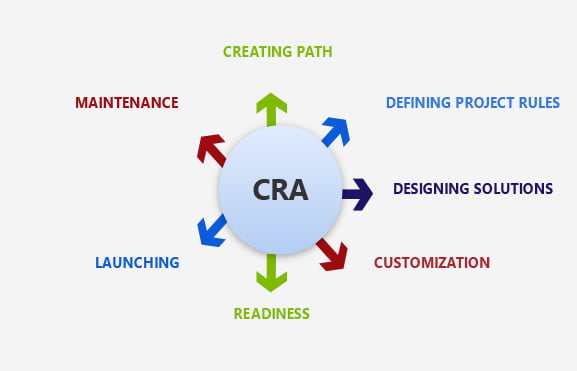

Meet a range of data management needs with solutions that help you achieve data governance goals.

To curate metadata, manage assets, and share knowledge, use machine learning.

To power big data analytics and applications, start with clean, current data.

Evaluate the importance and threat of private details. Assist in the safety of PII, PCI, and PHI.

To stop data breaches and other mistakes, safeguard your data assets and be clear about how you use them.

Modernize industry, technology, and data infrastructures, as well as develop new products and services or upgrade existing ones.

Data discovery findings should be fed into the rest of the CSE's data governance platform better visualize holistic data.
For over a decade, we’ve worked with numbers. In the case of enterprise data governance for strategic IT and business cooperation, no other vendor can offer you an advantage. The CSE EDGE’s Data Intelligence team comprises accredited experts who provide data catalog, data literacy, and automation capabilities so that all business stakeholders can discover, appreciate, control, and socialize data assets.
No other vendor can gather, turn, and feed metadata from a broad range of data sources, operating processes, business applications, and database schema into a central data catalog, making it usable and understandable through role-based, contextual views.
Analytics teams will start innovating and automating complex tasks and processes with machine learning techniques using practices and resources to maintain the data organization and quality. For example, customer data could be fed into models to decide how prospects within the sales pipeline should be prioritized. Since data governance practices ensure accurate and safe consumer data, teams can expand and sell more specifically.
Our cloud solutions help the global enterprise achieve business goals.

We work to identify the clients IT problem and offer the best solution. Time and again,we face a situation that demands agility and the right set of talent that can solve technology issues.
Learn More
Not all projects are about innovation. Some are those that add a feather in our cap no matter what we deliver and how. It was typically a government project that involved a lot of roadblocks right.
Learn More
Being an expert IT solutions partner in the US and worldwide, we are committed to delivering results that drive business growth. Our team recently worked with Neil Hoosier & Associates to resolve.
Learn More
Cybersecurity has become a business issue, not just an IT issue. From ransomware attacks and phishing scams to cyber insurance …

Over the past few years, businesses transformed how employees communicate and collaborate faster than almost anyone expected. Organizations rapidly adopted …
Continue reading “Businesses Modernized Communication Faster Than Security”
For years, businesses focused heavily on protecting physical infrastructure. Servers sat inside office buildings. Files lived on local drives. Employees …
Continue reading “The Modern Workplace Runs on Cloud Data, What Happens If It Disappears?”
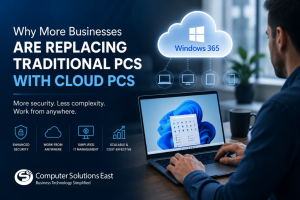
For years, businesses have relied on the same IT model: Buy laptops.Manage devices.Patch systems.Replace aging hardware.Repeat the process every few …
Continue reading “Why More Businesses Are Replacing Traditional PCs with Cloud PCs”